
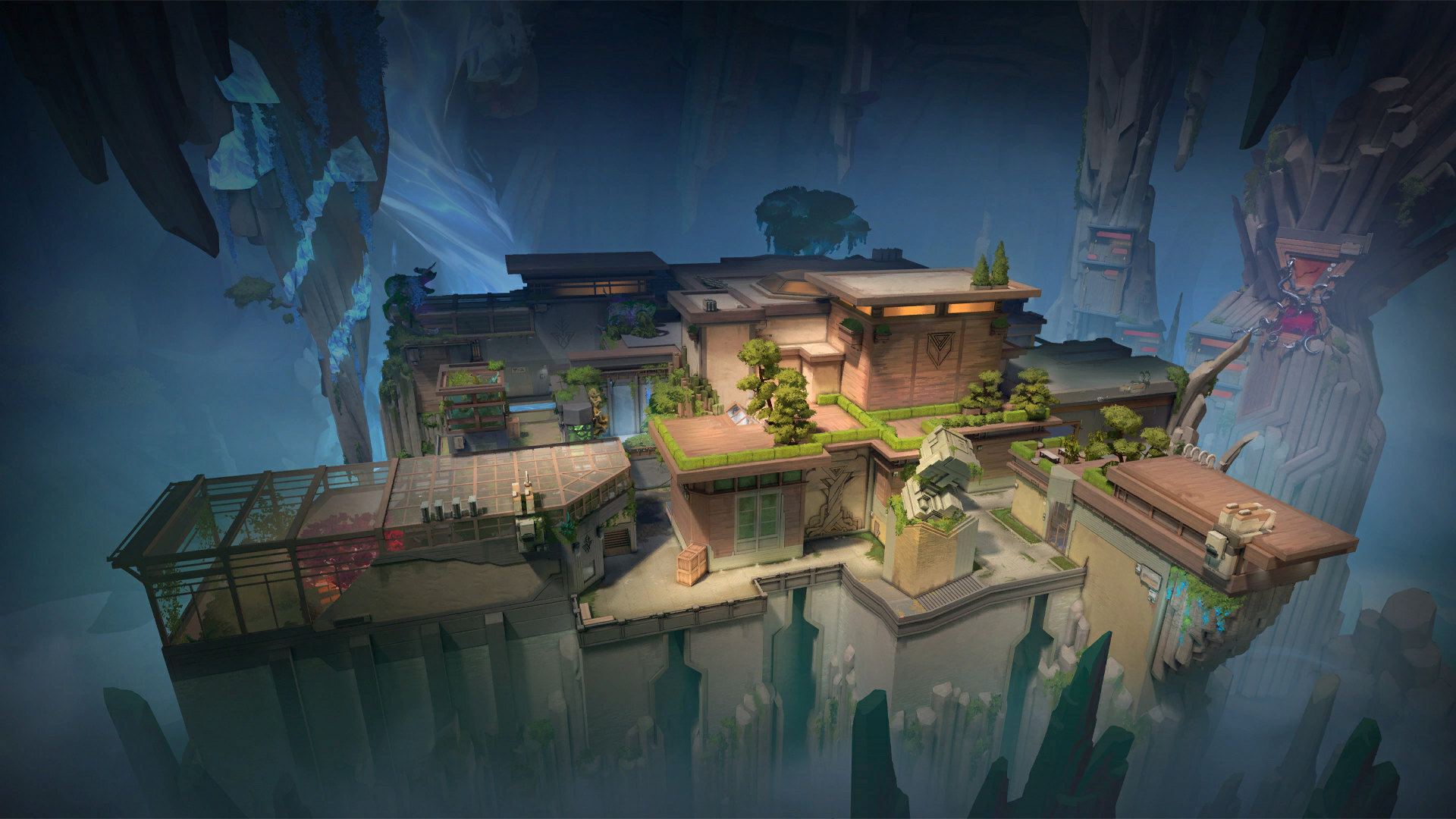

Understanding Valorant Maps Makes You Better on All of Them
Most players have strong maps and weak maps. They instalock their best agent without considering the map, rotate late because they do not understand the geometry, and lose site executes because they do not know which angles to clear first.
The solution is not to play only your three best maps — it is to build an architectural understanding of what type of map you are on and what that demands.
Map Archetypes
Two-Site Maps (most common)
The majority of Valorant's pool is two-site: Icebox, Ascent, Pearl, Sunset, Breeze, Fracture, Split, Bind. With two sites, the fundamental attacker decision is: where are the five defenders positioned? Two-site maps create an information game in the first 30 seconds — the team that identifies enemy position wins the round.
Standard defender setup: two on each site (one anchor, one off-angle), one mid player who can rotate or create crossfires. Identify the mid player early and you know where the remaining four are.
Three-Site Maps (Haven)
Haven is unique in the current map pool. Three sites fundamentally change the math: defenders must cover more space, attackers have more options, and mid control (Garage/A-Main) is critical for fast rotation to any site. The team that controls Haven mid usually controls round pace.
Long-Range Maps (Breeze, Icebox A-Side)
Some maps heavily reward long sightlines. Short-range utility like Breach and Raze loses value on Breeze because it cannot reach across the open B-Site. Sova, Chamber, and Jett's Tailwind thrive here. If you are playing a close-range agent on a long-range map, your team needs to create the space for you.
Vertical Maps (Icebox, Split)
Vertical maps introduce elevated positions that change head height, Turret scan zones, and Recon Bolt positioning. On Split, the elevation difference between Ropes and the site box means crosshair placement needs constant vertical adjustment.
The Mid Control Principle
Almost every Valorant map has a mid area connecting the sites. Controlling mid gives attackers:
- Faster rotations (shorter path to both sites)
- Crossfire setups (defenders face two directions)
- Information on where defenders are NOT
On Ascent, mid control through Market and Catwalk forces defenders to play site-isolated. On Split, controlling mid Vent allows the attack team to reach either site quickly.
Implication: Your first 45 seconds on attack should include some mid pressure, even without intending to take it. Whether defenders hold mid aggressively or retreat tells you the full defensive positioning.
Agent-Map Synergy
Choosing the wrong agent for a map is the most common agent-selection mistake:
Viper is exceptional on maps with long corridors — Icebox, Breeze, Haven. Less effective where her wall does not cut key sightlines.
Brimstone is strongest where his orbital smokes cover multiple chokepoints simultaneously — Ascent (Market + mid) and Split (top mid + B-Main). His limited smoke range makes him less ideal on large maps like Breeze.
Reyna is better on maps with clear 1v1 opportunities — close-range chokepoints, short corridors. Pearl B-Site and Bind A-Short are her environments. She struggles on maps requiring open-space crossings to reach the entry fight.
KAY/O: His Suppression Knife is most impactful where enemy abilities have high defensive value. On Lotus, suppressing a Killjoy during a B-Site execute removes the Turret and Alarmbot entirely — enormous trade of one ability charge.
Site Execution Architecture
Every site has the same basic structure:
- Entry angle (the first engagement zone)
- Default defensive position (where most defenders anchor)
- Off-angle positions (side, behind, elevated — the surprise engagements)
- Post-plant position (where spike is placed for maximum defuse difficulty)
Execution sequence: suppress off-angles → smoke standard sightlines → enter cleared space → plant at optimal post-plant position.
Post-plant positions worth studying:
- Ascent A-Site: Behind the back wall or Dice box; Sova Hunter's Fury covers the defuse angle through the wall
- Haven B-Site: Behind Boxes on the right side; spike in the corner maximises defuse time against CT and Garage retake
- Bind A-Site: Near Baths entrance; defenders rotate through teleporter from B — spike near the wall forces a long, exposed defuse
Rotation and Retake Timing
Rotation timing is one of the most impactful skills and one of the least practiced.
Rotate too early: You leave your original site open for a fake-into-real execute.
Rotate too late: The site is already taken, enemies are planted, and you are retaking against ability setups.
Correct rotation timing depends on two signals:
- The spike carrier has committed — the attacking team is physically entering the site, not probing
- You have identified the numbers — four or more players entering one site is a clear rotate signal
Use your mini-map constantly. Four blips entering one site is an unmistakable signal to rotate. One or two blips probing is information gathering, not a real execute — hold your position.
Summary
Map understanding pays compound returns — it improves every agent you play, every role you fill, and every tactical decision you make. Start by identifying the map archetype, then layer in agent-specific knowledge and site-specific execution patterns over time.
The players who thrive on every map are not those with the most callouts memorised. They are the ones who understand why certain angles exist and what to do about them.
Put This Into Practice
Get coaching tailored to your gameplay
Review a match with free AI coaching, then auto-record on desktop when you are ready.
Share this article